d100 or s2 pro ???

The D100 has 12 selectable ISO levels the S2 does not(only 6).
True. But what's the applicability? Do we really need 1/3 stop ISO settings, or is that just fodder for marketing brochures? To put it in perspective: in over a year of shooting with the D1x, I've used a total of 3 ISO values (100, 400, and 500, if you have to ask). The only time I used others was for testing in an article for the D1 Report.
The D100 has 3 selectable color spaces, the S2 does not(1).
True, but again, exactly what is the applicability? Since you can convert color spaces on the computer later, what exactly are you gaining? However, to Nikon's credit, their color spaces on the D1h and D1x seem to be relatively accurate, and Fuji doesn't seem to claim a color space for the S2 Pro (at least I've yet to find one in the manual that was posted).
The D100 has a custom tone curve import option, S2 does not.
Is anyone using this? I asked once before and was met with a loud silence from D1 users.
The D100 has + -5 adjustments in EV in auto mode, S2 does not(+ -3).
Again, seems like a marketing number to me. Just exactly when is it that I want to set an exposure 5 stops different than the meter?
The D100 has AE and WB bracketing, S2 does not(as far as I know).
Good point (at least on the WB bracketing; the S2 has AE bracketing).
The D100 has near 3fps shooting speed the S2 is specified to have
only 2fps.
Also a good point (for some shooters), though you also need to point out buffer sizes (this was an issue with the Canon 1D versus the Nikon D1h: Canon claims a much faster frame rate, but the size of its buffer means that the entire burst lasts two seconds. In some sports, that's okay, in others, it's not and the Nikon D1h is a better choice as it takes about 8 seconds to fill its buffer).

I hope my points aren't taken as defensive, here. I keep hearing about differences in product specifications, but no clear reasoning why those differences might be useful. There's a big difference between wanting one camera over the other versus needing one camera over the other.

--
Thom Hogan
author, Nikon Field Guide
author, Nikon Flash Guide
author, Complete Guide to the Nikon D1, D1h, & D1x
http://www.bythom.com
 
The D100 has 12 selectable ISO levels the S2 does not(only 6).
True. But what's the applicability? Do we really need 1/3 stop ISO
settings, or is that just fodder for marketing brochures? To put it
in perspective: in over a year of shooting with the D1x, I've used
a total of 3 ISO values (100, 400, and 500, if you have to ask).
The only time I used others was for testing in an article for the
D1 Report.
The D100 has 3 selectable color spaces, the S2 does not(1).
True, but again, exactly what is the applicability? Since you can
convert color spaces on the computer later, what exactly are you
gaining? However, to Nikon's credit, their color spaces on the D1h
Hmm, Thom with all respect, but this just can't be correct. If you have a sRGB color space, you will not be able to convert that to AdobeRGB and utilise the full AdobeRGB color space. What is lost is lost, no matter what. It is possible to convert from AdobeRGB to sRGB, not the other way round. Or perhaps I have misunderstood something?
The D100 has a custom tone curve import option, S2 does not.
Is anyone using this? I asked once before and was met with a loud
silence from D1 users.
Even if you don't use it, or that you didn't get any response doesn't mean that nobody use it. If it is implemented, you can use it. If it's not, you can't.
It sounds like if You don't use it it's not worth having.
Geir Atle
 
I think that the best example is people "perseiving" the WinTel as good, even as good as Mac.

My wife got a new 1.6Giga Hz P4 for the house and I have used it for a while... this was like going from europ (Mac) to a banana republic -I am from Nicaragua, and I love my banana country, but maybe you can get my point--, a world wher things are made cheap and carelessly with no elegance at all.

This incredibly low quality world is accepted by 95% of the world as fine. So I should stay with the 5% living in a secretly better world..
even if something is proven technically better but in our mind we
beleive something else is better then end of story,well for the
most part this is true and i think camera brands maybe one of the
worst ie the never ending nikon/cannon debate shrug

but i think if you asked random people on the street what is better
nikon or fuji then i think it would weigh in nikon favour only
becase most people (except for camera buffs) perceive nikon as a
camera maker and fuji as a film maker even though we all here know
that fuji make great cameras as well
I have used fujifilm film more than Nikon cameras -well, I don't
think that you can compare film to photo equipment,- can you?
Anyways, my point is that this two companies are among the best
product makers in my profetional life. (not because I had a one man
show in Fujifilms gallery in Ginza once), this is to respond to
someone that said that did't want to have the Fuji logo in his
neck. That is a good logo to have. -As good as Mamiya- and then the
convination Fuji Nikon (as you know, the body in the S2 pro is
that) is a good thing to have.

For me image superiority is the most important because I am a
comertial worker, but I think that everyone should pick what is
best for them and stop being dogmatick about brands. That is my
humble...

Frank Barret
--
Frank Barret
 
Things I like about the S2 (more or less in order of importance to me):

1. Insane resolution

2. Ability to shoot multi-exposures (Something that I really like to do with film, and would hate to lose in digital)
3. Firewire
4. Compatibility with my existing Nikon flash units

5. PC-synch socket (a minor thing, I know, but still a plus as I do a lot of studio work and currently have no radio-slave)
6. The ability to use smartmedia in an emergency
7. The ability to use AA batteries in an emergency
8. ISO 100

I also like having the option of the in-camera interpolated files, since it would save me a step of SI or genuine fractals if/when I need the bigger file. (I think, obviously I haven't tried it yet, so who knows.)

In any case, unless the reviews start coming in very anti-S2, it will be my choice over D100 - but we'll see.

Dying to get my hands on one of those two in any case.
I'm very confused: I heard a lot about both s2 and d100.
What to choose ??
thanks a lot !
Tommaso
--
Charles Bandes
http://www.bandesphoto.com
 
yes you are correct , d100 manual does state can be used in manual mode
without using built in meter
yes it can it just cant use matrix metering
Try reading the publically available manual: the S2 cannot meter
with AI or AI-S lenses, same as the D100.

--
Thom Hogan
author, Nikon Field Guide
author, Nikon Flash Guide
author, Complete Guide to the Nikon D1, D1h, & D1x
http://www.bythom.com
 
NOOOOOOOOOOOOOOOOO not a mac vS windows debate haha

personally i choose the 95% but then again i have wool on my back haha
My wife got a new 1.6Giga Hz P4 for the house and I have used it
for a while... this was like going from europ (Mac) to a banana
republic -I am from Nicaragua, and I love my banana country, but
maybe you can get my point--, a world wher things are made cheap
and carelessly with no elegance at all.

This incredibly low quality world is accepted by 95% of the world
as fine. So I should stay with the 5% living in a secretly better
world..
even if something is proven technically better but in our mind we
beleive something else is better then end of story,well for the
most part this is true and i think camera brands maybe one of the
worst ie the never ending nikon/cannon debate shrug

but i think if you asked random people on the street what is better
nikon or fuji then i think it would weigh in nikon favour only
becase most people (except for camera buffs) perceive nikon as a
camera maker and fuji as a film maker even though we all here know
that fuji make great cameras as well
I have used fujifilm film more than Nikon cameras -well, I don't
think that you can compare film to photo equipment,- can you?
Anyways, my point is that this two companies are among the best
product makers in my profetional life. (not because I had a one man
show in Fujifilms gallery in Ginza once), this is to respond to
someone that said that did't want to have the Fuji logo in his
neck. That is a good logo to have. -As good as Mamiya- and then the
convination Fuji Nikon (as you know, the body in the S2 pro is
that) is a good thing to have.

For me image superiority is the most important because I am a
comertial worker, but I think that everyone should pick what is
best for them and stop being dogmatick about brands. That is my
humble...

Frank Barret
--
Frank Barret
 
The D100 has 12 selectable ISO levels the S2 does not(only 6).
True. But what's the applicability? Do we really need 1/3 stop ISO
settings, or is that just fodder for marketing brochures? To put it
in perspective: in over a year of shooting with the D1x, I've used
a total of 3 ISO values (100, 400, and 500, if you have to ask).
The only time I used others was for testing in an article for the
D1 Report.
The D100 has 3 selectable color spaces, the S2 does not(1).
True, but again, exactly what is the applicability? Since you can
convert color spaces on the computer later, what exactly are you
gaining? However, to Nikon's credit, their color spaces on the D1h
Hmm, Thom with all respect, but this just can't be correct. If you
have a sRGB color space, you will not be able to convert that to
AdobeRGB and utilise the full AdobeRGB color space. What is lost is
lost, no matter what. It is possible to convert from AdobeRGB to
sRGB, not the other way round. Or perhaps I have misunderstood
something?
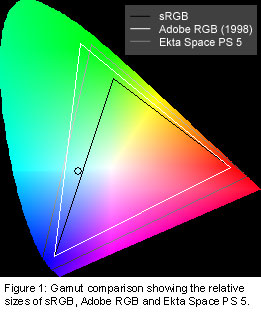
You have it right Geir, the Adobe RGB color space has quite a wider gamut (lots more blues and greens) than sRGB these values can only be approximated in a color space conversion that goes from Adobe to sRGB where as going in the other direction most every value in sRGB is mapped to the same color in AdobeRGB since sRGB is a subset of it. (See image below)


If you are aware of the gamut of your final output media (usually some printing rig) as being AdobeRGB or expanded sRGB shooting in this mode would capture subtletly of color in the final print that sRGB can't, definitely a reason to merit it's use under the applications that would benefit from it. ie. scenes with lots of vibrant blues and greens.
The D100 has a custom tone curve import option, S2 does not.
Is anyone using this? I asked once before and was met with a loud
silence from D1 users.
Even if you don't use it, or that you didn't get any response
doesn't mean that nobody use it. If it is implemented, you can use
it. If it's not, you can't.
Thom has a point, I too have been unable to track down anyone really using the custom tone curve quite to my suprise. However, if it is indeed an adjustment to the internal curves of the camera than it can be used to produce perfectly highlight controlled or shadow detailed images depending on the scene. Under very bright or high contrast lighting you can choose a curve that maximizes the use of DR where it's important. I have elaborated on this possibility in many previous posts which is why I didn't explain in my listing in the previous post but to me this single feature is packed with creative possibilities if the photographer knows how to take advantage of it.

Regards,

--

 
The D100 has 12 selectable ISO levels the S2 does not(only 6).
True. But what's the applicability? Do we really need 1/3 stop ISO
settings, or is that just fodder for marketing brochures? To put it
in perspective: in over a year of shooting with the D1x, I've used
a total of 3 ISO values (100, 400, and 500, if you have to ask).
The only time I used others was for testing in an article for the
D1 Report.
Hmm..I think that providing the options expands creative possibilities for the photographer, it's there if you want to use it. Unlike the competition where it's not, I can envision situations where you'd want to provide just the right amount of blur say in your motion under certain lighting with the standard ISO's you are stuck with the blur that can be had by adjusting S and A which may not be fine grained enough for the artistic affect you would like to produce. Additionaly, did noise at high ISO affect your choices any? If so the D100 has better noise performance (in most cases) than the previous D cameras this opens the possibilities of using those highier ISO's without incurring distracting noise.
The D100 has 3 selectable color spaces, the S2 does not(1).
True, but again, exactly what is the applicability? Since you can
convert color spaces on the computer later, what exactly are you
gaining?
Actually, though you can convert color spaces after the shot is taken you can't resample the original scenes color space in other words if you shoot in sRGB a scene where AdobeRGB values dominate, you will be capturing the scene incompletely compared to if you shot in AdobeRGB in the first place. The missing values can't be recovered and in converting on the PC can't be regenerated (all it has is the sRGB data to map to AdobeRGB which should be easy given that sRGB is a subset of AdobeRGB) but that sRGB can't contain the unshot components of color in the scene that existed in the AdobeRGB space.
However, to Nikon's credit, their color spaces on the D1h
and D1x seem to be relatively accurate, and Fuji doesn't seem to
claim a color space for the S2 Pro (at least I've yet to find one
in the manual that was posted).
I agree.
The D100 has a custom tone curve import option, S2 does not.
Is anyone using this? I asked once before and was met with a loud
silence from D1 users.
I too have been unable to track down anyone really using the custom tone curve quite to my suprise. However, if it is indeed an adjustment to the internal curves of the camera than it can be used to produce perfectly highlight controlled or shadow detailed images depending on the scene. Under very bright or high contrast lighting you can choose a curve that maximizes the use of DR where it's important. When you shoot under conditions that require highier DR than the camera is capable of, you can (using a properly shaped curve) distribute the use of your available DR to maximize visual impact or produce an artistic affect in camera . I have elaborated on this possibility in many previous posts which is why I didn't explain in my listing in the previous post but to me this single feature is packed with creative as well as technical possibilities if the photographer knows how to take advantage of it.
The D100 has + -5 adjustments in EV in auto mode, S2 does not(+ -3).
Again, seems like a marketing number to me. Just exactly when is it
that I want to set an exposure 5 stops different than the meter?
Expanded creative possibilities. Who knows what fish swims in the mind of an artist? Though I must admit since I don't like shooting in auto mode, this would be rarely used by me .
The D100 has AE and WB bracketing, S2 does not(as far as I know).
Good point (at least on the WB bracketing; the S2 has AE bracketing).
The D100 has near 3fps shooting speed the S2 is specified to have
only 2fps.
Also a good point (for some shooters), though you also need to
point out buffer sizes (this was an issue with the Canon 1D versus
the Nikon D1h: Canon claims a much faster frame rate, but the size
of its buffer means that the entire burst lasts two seconds. In
some sports, that's okay, in others, it's not and the Nikon D1h is
a better choice as it takes about 8 seconds to fill its buffer).

I hope my points aren't taken as defensive, here. I keep hearing
about differences in product specifications, but no clear reasoning
why those differences might be useful. There's a big difference
between wanting one camera over the other versus needing one camera
over the other.
No offense taken Thom. I've actually listed these reasons in previous threads over the last few months but neglected to do so in my listing of D100 advantages in my first posting.(my bad)

Regards,
--

 
Personally, I don't like multi-exposures. I have a F4E and a F5, both have the feature. But it is just not for me.

And I think for a digital camera to have multi-exposure is a bit pointless. After all, it is extremely easy to do it in software like Photoshop. And it is one of the point to use digital. But for sure, it is a nice to have feature. Again, it is a matter of personal choice.

****
1. Insane resolution
2. Ability to shoot multi-exposures (Something that I really like
to do with film, and would hate to lose in digital)
3. Firewire
4. Compatibility with my existing Nikon flash units
5. PC-synch socket (a minor thing, I know, but still a plus as I do
a lot of studio work and currently have no radio-slave)
6. The ability to use smartmedia in an emergency
7. The ability to use AA batteries in an emergency
8. ISO 100

I also like having the option of the in-camera interpolated files,
since it would save me a step of SI or genuine fractals if/when I
need the bigger file. (I think, obviously I haven't tried it yet,
so who knows.)

In any case, unless the reviews start coming in very anti-S2, it
will be my choice over D100 - but we'll see.

Dying to get my hands on one of those two in any case.
I'm very confused: I heard a lot about both s2 and d100.
What to choose ??
thanks a lot !
Tommaso
--
Charles Bandes
http://www.bandesphoto.com
 
"When is an innovation not an innovation?

When it is a solution in search of a problem!"

I read this quote in a photography magazine about twenty years ago when they were writing about the latest geewiz innovation. It is still true today.

I think Thom is trying to say don't get lost in the details as much of the details is marketing hype.

Compared to twenty years ago, I love the cameras we have today and the use of digital photography BUT

Are we really getting better pictures?

Bottom line -

The Nikon D100, Fuji S2, Canon D30 are basicly equals. Buy want you want and don't worry about the details!
 
I don’t think we have the right to ask Thom to tell us what he knows. First, he signed a NDA. Second, he do that for living. I don’t think our Right to Know is more important than his right.
If someone want to talk about some insider news, they will.

****
Does this mean you can start talking about what you know about the
S2 or is this still "publicly available information"?
At present, I'm restricting myself to information that is
publically available. For what it's worth, I usually do that
regardless of whether I've signed an NDA with someone. We already
have plenty of folk willing to speculate and cause confusion.

--
Thom Hogan
author, Nikon Field Guide
author, Nikon Flash Guide
author, Complete Guide to the Nikon D1, D1h, & D1x
http://www.bythom.com
 
My point with the D100's sensor beig a Sony is that there are so many people that defend the model only because it is part of the Nikon family, I think that Fuji knows more about color and photography than Sony does, but I have no hard evidence, so this is only an oppinion.

Anyways, we are only killing time until the world final match of D100 against S2 in this Website takes place. Any moment now...

Bytheway, I saw the Canon D60 spread today in my Photo District News June edition... It looks fantastic, no grain at all...
The most importan thing is the sensor, and Nikon did not make that
one.
While the sensor is certainly one critical component of the image
quality of a digital camera, it is NOT the only one. You also have
an A/D converter which must be absolutely linear in response, the
filter array, and demosaicing hardware built in DSP.

Consider the realm of the consumer digital camera (Coolpix, et.
al.). Perhaps 80% of those all use the same source for sensors:
Sony. So why does the output look so different amongst all those
cameras? It's not simply the lens that's making all that difference
(though it does enter into the picture, so to speak). Much of the
difference happens at the DSP.

I'll make a prediction here: we won't know the true image quality
capability of either camera until the same third party demosaicing
routines exist for both raw formats (RAF and NEF).

--
Thom Hogan
author, Nikon Field Guide
author, Nikon Flash Guide
author, Complete Guide to the Nikon D1, D1h, & D1x
http://www.bythom.com
--
Frank Barret
 
My point with the D100's sensor beig a Sony is that there are so
many people that defend the model only because it is part of the
Nikon family, I think that Fuji knows more about color and
photography than Sony does, but I have no hard evidence, so this is
only an oppinion.
The colors is not made by the sensor, that is a mix in the software. So the colors is not made by Sony, but by Nikon. I think Nikon knows just as much as Fuji about colors. It's a desicion: Vibrant/vivid/colorfull or "neutral" accurate. I prefere a camera that matches the exact colors, even if they tend to be more "dull".

If the colors was made by the sensor, there wouldn't be possible to make any "color adjustment" in the firmware.
Anyways, we are only killing time until the world final match of
D100 against S2 in this Website takes place. Any moment now...
Agree, but I have already made my choice.

Geir Atle
 
Doesn't the battery situation on the S2 suck po-man's potatoes?
1. Insane resolution
2. Ability to shoot multi-exposures (Something that I really like
to do with film, and would hate to lose in digital)
3. Firewire
4. Compatibility with my existing Nikon flash units
5. PC-synch socket (a minor thing, I know, but still a plus as I do
a lot of studio work and currently have no radio-slave)
6. The ability to use smartmedia in an emergency
7. The ability to use AA batteries in an emergency
8. ISO 100

I also like having the option of the in-camera interpolated files,
since it would save me a step of SI or genuine fractals if/when I
need the bigger file. (I think, obviously I haven't tried it yet,
so who knows.)

In any case, unless the reviews start coming in very anti-S2, it
will be my choice over D100 - but we'll see.

Dying to get my hands on one of those two in any case.
I'm very confused: I heard a lot about both s2 and d100.
What to choose ??
thanks a lot !
Tommaso
--
Charles Bandes
http://www.bandesphoto.com
 
How articulate.

No, the S2 battery situation is actually a big plus. The AA batteries are available anywhere. Further, the capacity of them is always increasing, allowing you to take advantage of a changing technology. The S2s other batteries aren't needed if you don't use the built in flash.
Doesn't the battery situation on the S2 suck po-man's potatoes?
F. Dantzler
 
Geir, I also maid my choise, and it was because of two features that the S2 has, Firewire (to shoot thetered to the PC RAM / HardDisk) and the fact that I can set it to 200ASA. The first one was the deal maker for me. I will get mine the second week of July, one of the first to come, this is what the store wrote in a recent email:

"...I was contacted from Fuji headquarters this past Wednesday by the gentleman that allocates the Fuji S2's through their dealer network here in the United States. 1000 cameras are scheduled to arrive the second week of July. Tallyn's currently has 300 cameras on order and we are guaranteed 150 of the first shipment. There is a remote possibility that only 500 arrive in the U.S. If that is the case we are guaranteed 100 units. If you receive this e-mail, I assure you that you will receive one of the very first to arrive here in the U.S. "

So I didn't wait for the head to head results...
My point with the D100's sensor beig a Sony is that there are so
many people that defend the model only because it is part of the
Nikon family, I think that Fuji knows more about color and
photography than Sony does, but I have no hard evidence, so this is
only an oppinion.
The colors is not made by the sensor, that is a mix in the
software. So the colors is not made by Sony, but by Nikon. I think
Nikon knows just as much as Fuji about colors. It's a desicion:
Vibrant/vivid/colorfull or "neutral" accurate. I prefere a camera
that matches the exact colors, even if they tend to be more "dull".
If the colors was made by the sensor, there wouldn't be possible to
make any "color adjustment" in the firmware.

Anyways, we are only killing time until the world final match of
D100 against S2 in this Website takes place. Any moment now...
Agree, but I have already made my choice.

Geir Atle
--
Frank Barret
 
How many shots can ya get from 4 AAs?

Ribit.
No, the S2 battery situation is actually a big plus. The AA
batteries are available anywhere. Further, the capacity of them is
always increasing, allowing you to take advantage of a changing
technology. The S2s other batteries aren't needed if you don't use
the built in flash.
Doesn't the battery situation on the S2 suck po-man's potatoes?
F. Dantzler
 
The raw image is a 12 megapixel (not megabytes) size image, are you saying it's a true 12 megapixel CCD?

The sensor size is supposed to be 3024 x 2016 pixels = 6,096,384 pixels however the raw image is 4256 x 2848 = 12,121,088 pixels, where do these extra pixels come from if not interpolated?

Dennis D
That feature along
with the fact that the only choice for raw in the S2 is the large
interpolated one (no uninterpolated raw images available) has
caused me to go with the D100
The RAF file format is not interpolated, and requires a computer
based software tool to interpolate, just as does Nikon's NEF format.

--
Thom Hogan
author, Nikon Field Guide
author, Nikon Flash Guide
author, Complete Guide to the Nikon D1, D1h, & D1x
http://www.bythom.com
--
Dennis D
 
No, the S2 battery situation is actually a big plus.
Huh? The moron who designed the power distribution in the S2, should receive a prize for the most mentally deprived.

As long as you don't use the built-in flash your fine, you say, but that's kinda crazy. Since this is a pro camera, it should be made without so many consumer-grade problems, and everything should be integrated to function.

P.S. I've looked at the interpolated photos by the S2 and it should not be an option on the S2 or any S Series. It just sucks. Fuji should stick to 6MP and not try to cut corners, making everyone think it as a higher resolution, when that resolution has the highest interpolation and aliasing I have ever seen.

--
Forum:
http://pub103.ezboard.com/bthedigitaldinguscommunity

Websites:
http://e10club.topcities.com/
http://d100.topcities.com/
--

'I do just about everything in my CCDs...'
 
I will shoot in raw mode and process the images later most of the time to get maximum image quality.

NC2/3 will batch process the files while I attend to other matters.

I have only picked up cryptic snippets of info regarding Fujis raw processing offering.

I have yet to see any images that were captured raw and processed for maximum attainable image quality from either camera.

Rgds,
 

Keyboard shortcuts

Back
Top